

When to Put Winter Tires On in Ontario for the Back Roads Around Brockville, Ontario


When to put winter tires on in Ontario is decided by the thermometer, not the calendar. Put them on once the temperature stays at or below about seven degrees Celsius, the general rule of thumb tire makers and road-safety groups publish.
On the back roads around Brockville, Ontario, that usually happens during October, so book the swap early in the month and you are ahead of it.
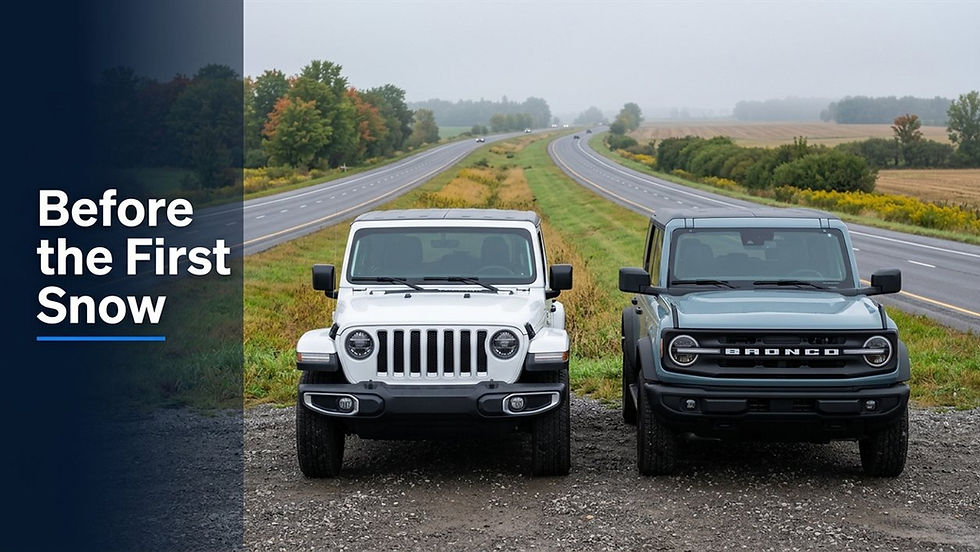
It is mid-September now, with warm afternoons, cool nights and the first colour showing on the maples.
Most winter tire advice online is written with the Greater Toronto Area in mind, where the cold tends to settle in later.
The service team at Brockville Ford on Eleanor Street has this conversation every fall with drivers from Elizabethtown-Kitley, Lyn, Maitland and Athens.
The answer does not change from year to year: watch the thermometer, and book before everyone else does.
Key Takeaways
The rule of thumb is temperature. Once it stays at or below about seven degrees, all-season rubber has stiffened and winter tires are the safer set.
Leeds and Grenville usually gets there weeks before the Greater Toronto Area, so province-wide advice runs late for the back roads around Brockville, Ontario.
Booking in early October means a time of your choosing. Waiting for the first snowfall means calling on the same morning as everyone else in Eastern Ontario.
A dealership swap covers more than the tires: pressures, wheel nuts, sensors, and a look at the brakes and tread while the wheels are off.
The Winter Tire Package at Brockville Ford is the simplest route to a proper set if last year's is done.
The Temperature Rule Decides When to Put Winter Tires On in Ontario
Switch to winter tires once the temperature stays at or below about seven degrees Celsius.
It is a temperature, not a date, and it holds for every make on the road. The rule of thumb is general guidance published by the Tire and Rubber Association of Canada and other road-safety groups, not a Ford figure.
Ontario does not require winter tires, and Quebec does, so here the choice is yours.
That is exactly why the calendar is the wrong tool for making it.
Tires are rubber, and rubber changes with temperature.
An all-season tire is built to stay flexible in warm and mild weather.
As the air cools, its compound stiffens, and a stiff tire cannot press into the road the way it did in August.
It still rolls fine. It does not stop the same.
That change arrives before the first flake falls, on a dry road on a bright October morning.
A winter tire uses a softer compound that stays pliable in the cold, plus a tread cut with small slits that bite into frost, slush and packed snow.
Look for the three-peak mountain and snowflake symbol on the sidewall, the mark of a true winter tire.
So the honest answer to when to put winter tires on in Ontario is a temperature, not a date.
One cold morning does not count. It is the stretch of days that stay at that level that tells you the season has turned.
An Escape, a Toyota RAV4 and a Honda CR-V all ride on the same kind of rubber, so the rule is the same for each.

When That Threshold Arrives in Leeds and Grenville
In Leeds and Grenville, the temperature usually settles at or below that seven-degree mark during October, so plan on an October swap, not a November one.
The back roads outside town tend to get there first, and province-wide advice written with the Greater Toronto Area in mind often runs a few weeks late here.
Here is why.
The river fog, the open fields of Elizabethtown-Kitley and Augusta, and the wind off the St. Lawrence all bring frosty mornings early to the concession roads out past Lyn and Athens.
The other difference is plowing.
Highway 401 and County Road 2 are cleared first. The township roads and back concessions come later, and they hold frost long after the main roads are dry.
If your morning drive to an appointment at Brockville General Hospital starts on a gravel concession, the first stretch is the coldest, least-treated road you will touch all day.
A simple way to keep it predictable, year after year:
Book the swap in early October, for a date in the middle of the month.
Use Thanksgiving weekend as your reminder to check the ten-day forecast.
If the forecast shows the temperature holding at or below seven degrees, keep the date. If it is still mild, ask to move it back a week.

Why Booking the Swap Early Matters on the Back Roads Near Brockville
Book the swap in early October, while you can still pick the day and the time of day that suit you.
The first real snowfall in Eastern Ontario does the same thing every year. Every driver who put it off calls the same morning.
Three reasons to book in early October rather than wait:
Safety on the first frost. The risky days are the clear, cold mornings before the snow, when the road looks dry and the all-seasons have already gone hard.
A set that arrives before it is needed. If last year's tires are worn, ordering early means the new set is mounted and ready before the first storm.
Storage and the spring. Ask about seasonal storage when you book; it is one less thing to lift and one less thing to remember in April.
No one rushes you. You book the swap, you show up, it gets done, and you drive home on the right tires.
The service desk on Eleanor Street would rather see you in October, at your own pace, than in a November snowstorm.

What a Dealership Winter Tire Swap Includes
A dealership winter tire swap covers the change itself, the tire pressures, the wheel nuts, the tire pressure sensors, and a look at the tread and brakes while the wheels are off.
It sounds like a few wheel nuts and a handshake. On a modern Escape or Bronco Sport, there is more to it.
Tires on their own wheels, or remounted
If your winter set lives on its own steel or alloy wheels, the swap is a straight change.
If the winter tires are loose, each one is dismounted, mounted and balanced fresh.
Pressures, torque and sensors
Every tire is set to the pressure printed on the door jamb, and the wheel nuts are torqued to specification.
The tire pressure sensors are checked so the warning light on the dash tells the truth all winter.
A look at both sets, and at the brakes
With the wheels off, the technician reads the tread and age of both sets and looks over the brakes.
Anything that needs attention is written up and put to you before any work is done. You decide, at your own pace.
The set that comes off is marked by position, then goes home in the back or into storage if you arranged it.
How to Tell if Last Year's Set Is Still Safe
Last year's winter tires likely have another season in them if the tread is deep enough, the rubber is not too old, and the sidewalls show no cracks or uneven wear.
A five-minute look in the garage before you book tells you which it is. If you are unsure, the service advisor will tell you plainly.
Three things to check:
Tread depth, with a toonie. If the tread reaches the bear's paws, the set has plenty of life left, and if it only reaches the letters "Canada", it is time to think about replacing it.
Age. Rubber hardens with the years, even in a dry garage, so good tread does not always mean a soft tire.
Cracks and uneven wear. Fine cracks along the sidewall, or one shoulder worn more than the other, mean the tire is past its best or the alignment needs a look.
The date of manufacture is stamped on the sidewall. If you cannot read it, the service advisor can.
If the set fails any of those checks, the Winter Tire Package page is where the current offer lives. If it passes, book the swap and carry on.
And if the vehicle under the tires is what you are rethinking this fall, a smaller SUV that is easy to climb into and simple to keep is a fair conversation to have.
The new Ford SUV lineup is a natural place to start, the Bronco Sport among them.
The pre-owned inventory at Brockville Ford is worth a look on the same visit, with nobody standing over you.
Frequently Asked Questions
Do I have to put winter tires on in Ontario
No. Ontario has no winter tire law, and Quebec does.
The choice is yours, and you could get a discount on your auto insurance for winter tires, so ask your broker once they are on.
The temperature rule decides it: switch once the temperature stays at or below about seven degrees.
Is late October too late to put winter tires on near Brockville
Later than ideal, but not too late. Around Brockville, the temperature usually settles at or below about seven degrees during October, which is why early October is the time to book.
If you are reading this in late October, book now rather than waiting for snow.
Does all-wheel drive mean I can skip winter tires on my Escape
No. All-wheel drive helps a vehicle get moving on a slippery surface.
It does not help you stop, and stopping is what matters at a stop sign on a frosty concession road.
Winter tires do the stopping; all-wheel drive is a helpful extra, not a replacement.
What if I only drive a little in the winter
The trips you do make are the ones that count: the morning appointment, the drive to church, the run into town after a storm.
Those are short, cold trips on untreated roads, which is exactly where winter tires earn their keep.
Low kilometres save tread, but the rubber still ages, so check the date on the sidewall each fall.
Get Ahead of Winter in Brockville, Ontario
The plain answer to when to put winter tires on in Ontario is once the temperature stays at or below about seven degrees.
On the back roads of Leeds and Grenville, that usually means October, not November, so book early and make it the same habit every year.
Book your winter tire swap online this fall, at your own pace, and be done before the weather turns.
Visit us at
25 Eleanor St.,
Brockville, ON
K6V 4H9
Browse inventory online, value your trade, get pre-approved on approved credit, book service, or contact our team.
Sales: (613) 342-0234 Parts: (613) 342-0234 Service: (613) 342-0234
About the author:
Kerry Irven is the Vice President of New and Used Automotive Operations for Heighton Automotive Group, a family-owned and operated automotive group serving communities across Eastern Ontario. Kerry began his automotive career in new-car sales, building his experience on the showroom floor and working his way through multi-store dealership operations.
With over 25 years in the automotive industry, Kerry has helped grow automotive businesses from one location with 40 to 50 vehicles in stock to more than 500 vehicles across 10 rooftops. His hands-on background in both new and used-vehicle operations gives him a practical understanding of what customers look for when shopping for their next vehicle.
Throughout his career, Kerry has always been actively involved in staff coaching and in understanding customer wants and needs, helping ensure the businesses he works with continue to adapt to what customers are truly looking for.
One of the most exciting chapters of his career has been the shift into modern automotive marketing, embracing new technology, transparent pricing, customer-first inventory strategies, and new ways to create a better vehicle-shopping experience.
Kerry has completed extensive automotive training, including certification through the Ontario Motor Vehicle Industry Council, involvement with the Used Car Dealers Association of Ontario, Canadian automotive dealer training, and multiple customer service courses.
Born and raised on a farm, Kerry has always valued family, hard work, and a practical, down-to-earth approach. Joining Heighton Automotive Group and working alongside Thomas Heighton and family, along with managing partners Kyle Lothian and Martin Gougeon, has allowed him to bring those same values into the car business. It has also allowed Kerry to continue following a simple philosophy: treat every customer exactly the way he would want to be treated.

Comments