

All Season vs All Weather Tires for the Highway 401 Commute From Brockville, Ontario


All season vs all weather tires comes down to one mark on the sidewall. All-weather tires carry the three-peak mountain snowflake symbol, which Canada's tire rules tie to a snow traction test, and a plain all-season tire does not.
For a daily run on the 401 to Kingston or Cornwall, all-weather tires are the compromise the tire industry calls them, and dedicated winter tires still win in severe snow, on ice and in deep cold.
We're Brockville Ford on Eleanor Street, and 401 commuters ask us this every year before the first cold snap.
Are all-weather tires good enough, or do you still need a set of winter tires?
This guide answers it with what Transport Canada, Canada's tire regulations, the Government of Ontario and the Tire and Rubber Association of Canada publish, and with the roads you actually drive.
It also covers where to get tires, when to book the changeover and what to check on the set you have. No tire brand is recommended here.
Key Takeaways
All-weather tires carry the three-peak mountain snowflake symbol. The Tire and Rubber Association of Canada says plain all-season tires do not.
Canada's tire regulations define a winter tire as one that passes a standard snow traction test and carries that symbol on its sidewall.
M+S means mud and snow. The Tire and Rubber Association of Canada uses it for all-season tires, and on its own it does not make a tire a winter tire.
The way we see it, all-weather tires suit a mostly-highway 401 commute with occasional, moderate snow. Dedicated winter tires still win in severe snow, on ice and in deep cold.
Ask your insurer whether your tires qualify for a winter tire discount, and look at our Winter Tire Package before you decide.
All Season vs All Weather Tires Come Down to the Symbol on the Sidewall
The difference is one mark: the three-peak mountain snowflake symbol.
The Tire and Rubber Association of Canada says all-season tires that carry the symbol are often called all-weather tires. It says plain all-season tires lack the symbol and do not meet the snow traction requirements to be considered a winter tire.
Next time you fill up on Stewart Boulevard, crouch down and look at your own sidewall. You will find the symbol, the letters M+S, both, or neither.
Transport Canada says tires marked with the symbol "meet specific snow traction performance requirements and have been designed specifically for use in severe snow conditions."
Canada's Motor Vehicle Tire Safety Regulations define a winter tire as one that passes a standard snow traction test and "is marked on at least one sidewall with the Alpine Symbol."
Transport Canada describes the Alpine symbol as a three-peak mountain and snowflake pictogram. It describes the test as traction testing on medium packed snow, compared against a reference test tire.
That makes the symbol a snow test. Transport Canada says a minimum government standard for winter tire performance on ice surfaces does not exist in Canada, the United States or the European Union.
So the symbol tells you the tire was built to pass a snow traction test. It does not tell you how the tire grips on ice.
That is the heart of all season vs all weather tires. An all-weather tire meets the same winter tire definition, the Tire and Rubber Association of Canada says, and it is still "a compromise."
What M+S Means on a Tire
M+S stands for mud and snow.
The Tire and Rubber Association of Canada uses the M+S mark to describe all-season tires. The Government of British Columbia's tire page lists M and S tires as mud and snow, or all-season, tires.
M+S is not the snowflake symbol. Canada's winter tire definition requires the symbol, so M+S on its own does not make a tire a winter tire.
British Columbia's page also notes that some manufacturers put both marks on one tire. On a tire with both, the snowflake symbol is the mark tied to the winter tire definition.
The Three Tire Types Side by Side
Here is how the three types line up, in words:
Tire type | Mark on the sidewall | What it is built for | A winter tire under Canada's definition |
|---|---|---|---|
All-season | M+S (mud and snow), no snowflake symbol | Milder conditions; Transport Canada says it begins to lose elasticity in the cold | No, per the Tire and Rubber Association of Canada |
All-weather | Snowflake symbol; some tires carry M+S as well | Year-round use and occasional, moderate snowfalls, per the Tire and Rubber Association of Canada | Yes, and the association still calls it a compromise |
Dedicated winter | Snowflake symbol | Winter use only, per the Tire and Rubber Association of Canada; softer rubber and more appropriate tread design, per Transport Canada | Yes |
Keep the symbol in mind when you look up tires for your vehicle. Sort out which of the three types you want before you compare anything else.

What All-Weather Tires Mean for a Highway 401 Commute From Brockville
All-weather tires fit a 401 commuter who wants one set all year and mostly drives cleared highway. The Tire and Rubber Association of Canada says they are designed for year-round use and occasional, moderate snowfalls.
Dedicated winter tires are the stronger choice when your drive includes severe snow, ice, deep cold or back roads that get ploughed later.
No source rules on your commute in particular. The answer depends on the whole drive, door to door.
Picture the run to Kingston before sunrise. Most of your kilometres are at highway speed past Mallorytown and Lansdowne, on salt and slush, on a main route that is usually cleared ahead of the back roads.
The run east to Cornwall, past Prescott and Cardinal, is much the same: long stretches at highway speed.
The part of the drive that tests your tires is often the first and last few kilometres. That means the side road out of Elizabethtown-Kitley or Augusta, the on-ramp at the edge of town, and the unploughed corner of the parking lot at work.
The Tire and Rubber Association of Canada says all-season tires with the symbol do offer better traction than all-season tires without it.
It also says they "may not provide the grip needed for severe winter driving conditions common on Canadian roads."
All-weather tires suit you if:
Most of your winter kilometres are on the 401 and main roads that are cleared ahead of the back roads.
You want one set on the car all year, with no changeover twice a year and no second set to store.
The snow on your route is occasional and moderate rather than severe.
Dedicated winter tires suit you if:
Your drive starts or ends on a concession road in Leeds and Grenville that is ploughed later than the highway.
You drive in the dark on the coldest mornings, before the ploughs and salt trucks have finished.
You want the most grip available in severe snow, on ice and in deep cold.
Neither list is a rule. It is how we would weigh it, and our service team will weigh it with you, with your route and your current tires in front of us.

Where Dedicated Winter Tires Still Win on the Back Roads of Leeds and Grenville
Dedicated winter tires still win in severe snow, on ice and in deep cold. Transport Canada says they give better traction than all-season tires because they are made of softer rubber and have more appropriate tread design.
The Tire and Rubber Association of Canada says all-weather tires meet the winter tire definition and are still a compromise.
Think of a dark morning on a concession road near Athens or Lyn, or on the Thousand Islands Parkway toward Gananoque, before the plough has been through. If that is the start of your commute, read this section twice.
Transport Canada puts the cold plainly: "At temperatures below 7°C, all-season and summer tires begin to lose elasticity, leading to less traction."
It adds that "Winter tires keep their elasticity and grip at much lower temperatures." Transport Canada does not say where all-weather tires sit on that scale, so we will not guess.
The Tire and Rubber Association of Canada says dedicated winter tires are designed to be used only in winter. It says they use "soft tread compounds that retain flexibility" in deep cold.
Transport Canada recommends "using winter tires on all wheels for driving in cold, snowy or icy conditions."
Transport Canada also says to install winter tires in sets of four, to help maintain control and stability in icy conditions. The Government of Ontario's winter driving page says "Be sure to install four winter tires" and "never mix different types of tires on one vehicle."
If dedicated winter tires are the answer for your drive, ask us about our Winter Tire Package.

Do All-Weather Tires Count for the Ontario Winter Tire Insurance Discount
Ask your insurer whether your tires qualify before you buy. Ontario does not require winter tires, and the Government of Ontario says winter tires could get you a discount on your auto insurance, and to ask your insurance provider.
Whether all-weather tires count is your insurer's call, and we will not guess at it.
Transport Canada notes that provinces and territories decide whether to require winter tires.
It also says insurance companies "may also give you a discount if you use winter tires."
Put the question to your insurer in plain terms: do my tires qualify? Then choose the set that fits the drive.
Before you call, our service team can show you which mark your current tires carry, so you know exactly what you are asking about.
Where Can I Get Tires in Brockville and When Should I Book the Changeover
You can get tires, the Winter Tire Package and the seasonal changeover under one roof at Brockville Ford on Eleanor Street. Book the changeover before the first cold snap, while you can still pick a time that suits your commute.
Transport Canada's cold line is the one to watch: it says all-season and summer tires begin to lose elasticity below 7°C.
Start from home if you like. You can shop tires online and come in when it suits you.
Book your tire changeover online and pick a time that fits around your shift.
Not sure when to make the swap? Our guide on when to put winter tires on in Ontario walks through the timing around Brockville.
What Should I Check on My Current Tires Before the First Cold Snap
Start with the sidewall and the pressure gauge. Look for the snowflake symbol, M+S or both, and check the pressure when the tires are cold, because Transport Canada says tire pressure goes down in the cold.
Do it in the driveway before the first run up the 401, not at the side of the road near Lansdowne.
Here is the short list:
The mark: snowflake symbol, M+S, or both. The symbol is the one tied to Canada's winter tire definition.
The pressure: check it cold, first thing in the morning, not in a parking lot on King Street after the car has warmed up.
The set: if you run winter tires, Transport Canada says to install them in sets of four.
The condition: if anything about the tread or the sidewall looks off, have our service team look at it before winter.
The insurer: ask whether your tires qualify for a winter tire discount before you buy.
If you drive a Ford, find out what Ford Roadside Assistance covers, so you know who to call on a dark stretch of the 401.
Is the Vehicle Under the Tires Due for a Change
Sometimes the tire question turns into a vehicle question. If your car is due for a change anyway, sort that out first, then choose tires for the vehicle you will drive when the snow comes.
Tires and drivetrain are separate decisions, and the tire choice in this guide applies to whatever you drive.
Our all-wheel-drive Ford lineup is a practical place to start browsing.
If a hybrid is on your list, our look at the Ford Maverick hybrid AWD for the Highway 401 commute is written for the same drive.
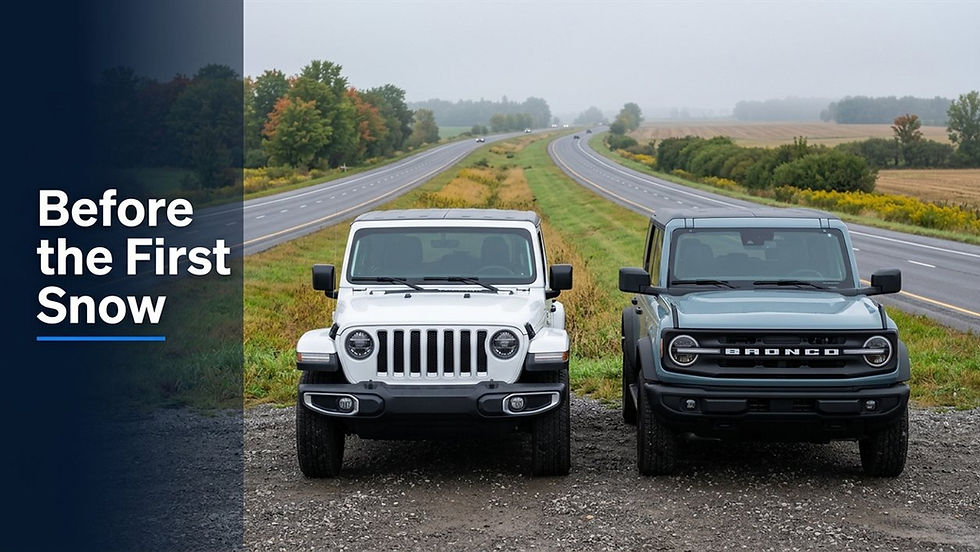
Our comparison of the Bronco vs Wrangler in winter on the Highway 401 commute covers the vehicle side of the same winter.
See what your current vehicle is worth before you decide. Ask us about financing too, O.A.C.
Why Get Your Tires at Brockville Ford
Your tires, your changeover and your regular service all happen at one address on Eleanor Street, with people who will talk it through at your own pace.
We would rather you leave with the right set for your drive than with a sales pitch.
What that looks like:
Shop tires online, then have them fitted here.
The Winter Tire Package, for drivers who want dedicated winter tires.
Online booking for the changeover through our service scheduler.
Pressure-free advice on all-season, all-weather or winter tires for the drive you make.
You do not have to take our word for it: read what our customers say.
Frequently Asked Questions
What is the difference between all season and all weather tires
All-weather tires carry the three-peak mountain snowflake symbol, and the Tire and Rubber Association of Canada says plain all-season tires do not. Canada's tire regulations define a winter tire as one that passes a standard snow traction test and carries that symbol on its sidewall.
The association says all-weather tires meet that definition and are still a compromise, designed for year-round use and occasional, moderate snowfalls.
Are all weather tires good for winter in Ontario
They suit a commuter who mostly drives cleared highway and sees occasional, moderate snow, which is how the Tire and Rubber Association of Canada describes their design. Dedicated winter tires still win in severe snow, on ice and in deep cold.
Transport Canada recommends using winter tires on all wheels for driving in cold, snowy or icy conditions.
Does M+S mean a tire is a winter tire
No. M+S stands for mud and snow, and the Tire and Rubber Association of Canada uses it to describe all-season tires.
Canada's winter tire definition requires the three-peak mountain snowflake symbol, so M+S on its own does not make a tire a winter tire. Some tires carry both marks.
Do all weather tires qualify for the Ontario winter tire insurance discount
Ask your insurer whether your tires qualify. The Government of Ontario says winter tires could get you a discount on your auto insurance, and to ask your insurance provider.
Whether all-weather tires count is your insurer's call, so get the answer before you buy.
Where can I get tires and a changeover in Brockville, Ontario
Brockville Ford sells tires and does the seasonal changeover at our store on Eleanor Street. You can shop tires online, ask about the Winter Tire Package, and book the changeover online.
Book before the first cold snap, so you can pick a time that suits your commute.
Talk Tires With the Service Team in Brockville, Ontario
The simplest way to settle all season vs all weather tires for your commute is a short conversation with our service team, with your route and your current tires in front of us. Bring the car in and we will show you which mark your tires carry.
We see drivers from Prescott, Athens, Mallorytown, Lyn, Maitland, Cardinal, Elizabethtown-Kitley and Augusta, and from along the 401 in Gananoque, Kingston and Cornwall.
Find us on Eleanor Street, or book your tire changeover online at a time that suits your commute.
Get it settled before the first cold snap, pressure-free and at your own pace.
Visit us at
25 Eleanor St.,
Brockville, ON
K6V 4H9
Browse inventory online, value your trade, get pre-approved on approved credit, book service, or contact our team.
Sales: (613) 342-0234 Parts: (613) 342-0234 Service: (613) 342-0234
About the author:
Kerry Irven is the Vice President of New and Used Automotive Operations for Heighton Automotive Group, a family-owned and operated automotive group serving communities across Eastern Ontario. Kerry began his automotive career in new-car sales, building his experience on the showroom floor and working his way through multi-store dealership operations.
With over 25 years in the automotive industry, Kerry has helped grow automotive businesses from one location with 40 to 50 vehicles in stock to more than 500 vehicles across 10 rooftops. His hands-on background in both new and used-vehicle operations gives him a practical understanding of what customers look for when shopping for their next vehicle.
Throughout his career, Kerry has always been actively involved in staff coaching and in understanding customer wants and needs, helping ensure the businesses he works with continue to adapt to what customers are truly looking for.
One of the most exciting chapters of his career has been the shift into modern automotive marketing, embracing new technology, transparent pricing, customer-first inventory strategies, and new ways to create a better vehicle-shopping experience.
Kerry has completed extensive automotive training, including certification through the Ontario Motor Vehicle Industry Council, involvement with the Used Car Dealers Association of Ontario, Canadian automotive dealer training, and multiple customer service courses.
Born and raised on a farm, Kerry has always valued family, hard work, and a practical, down-to-earth approach. Joining Heighton Automotive Group and working alongside Thomas Heighton and family, along with managing partners Kyle Lothian and Martin Gougeon, has allowed him to bring those same values into the car business. It has also allowed Kerry to continue following a simple philosophy: treat every customer exactly the way he would want to be treated.

Comments